
A Practical Guide for Plano, Frisco, Allen, Dallas & North Texas Homeowners
A homeowner planning a remodel usually has one decision to make before choosing cabinets, flooring, paint colors, or countertops:
Are we remodeling this house for the next buyer–or for ourselves?
The answer changes almost everything…
If you’re preparing to sell, a $60,000 kitchen renovation may not make sense if buyers in your neighborhood aren’t likely to pay enough to justify the investment. A more targeted update fresh paint, improved lighting, updated hardware, repairs, or a modest kitchen refresh may make more financial sense.
But if you’re staying for another 10 or 15 years, the calculation changes completely.
You may care less about recovering every dollar at resale and more about creating a kitchen that works better, a bathroom that feels more comfortable, or a home that finally matches the way your family lives.
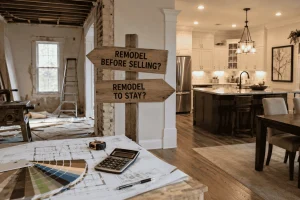
That’s the difference between remodel before selling and remodel for your forever home.
Neither strategy is automatically better.
The right approach depends on your timeline, neighborhood, home’s current condition, budget, lifestyle, and what you realistically expect to do next.
And for homeowners in Plano, Frisco, Allen, Dallas, and surrounding North Texas communities, those details matter. Local housing conditions can change, and even nearby neighborhoods can have very different buyer expectations.
For example, Redfin’s June 2026 data showed a median sale price of roughly $530,000 in Plano and approximately $675,000 in Frisco, with both markets showing year-over-year price declines at that point.
That doesn’t tell a homeowner exactly what their property is worth, but it does reinforce why remodeling decisions should be based on the specific property and local market, not a generic national ROI percentage.
First Question: Are You Selling Soon or Staying?
Before discussing countertops or flooring, establish your timeline.
If you’re likely to sell within 1–3 years
Your remodeling decisions should generally focus on:
- Fixing obvious defects.
- Improving first impressions.
- Removing dated or highly personal finishes.
- Improving functionality.
- Addressing deferred maintenance.
- Bringing important rooms up to the expectations of comparable homes.
- Avoiding highly customised improvements that primarily benefit your personal taste.
If you’re staying 5–10+ years
The priorities become broader:
- Better daily functionality.
- Long-term durability.
- Energy efficiency.
- Storage.
- Layout improvements.
- Accessibility and flexibility.
- Higher-quality materials.
- Personal design preferences.
- Spaces that can adapt as your family changes.
Remodeling Before Selling: Think “Buyer Appeal,” Not “Perfect House”
If you’re preparing to list your home, it’s tempting to remodel everything.
That can be a costly mistake.
A house doesn’t necessarily need a completely new identity before it goes on the market.
Instead, ask:
What will make a buyer more comfortable saying yes?
Sometimes the answer is surprisingly simple.
- Fresh paint.
- A kitchen that no longer looks obviously dated.
- A bathroom that feels clean and current.
- Better lighting.
- Updated flooring.
- A repaired roof.
- Improved curb appeal.
- Functional storage.
A home that feels maintained rather than neglected.
The 2025 Remodeling Impact Report from the National Association of REALTORS® and National Association of the Remodeling Industry found that REALTORS® most commonly recommended painting the entire home, painting an interior room, and addressing roofing before selling. REALTORS® also reported that kitchen upgrades, roofing, and bathroom renovations were among the projects seeing increased buyer demand.
Selling-focused remodeling isn’t necessarily about creating the most luxurious house possible.
It’s about removing reasons for buyers to hesitate.
The “Don’t Over-Remodel” Rule
One of the easiest ways to waste money before selling is improving a house far beyond what the surrounding market supports.
Imagine a neighborhood where most comparable homes have functional but moderately updated kitchens.
You install a highly customised, premium kitchen with expensive finishes, specialised appliances, and design details chosen specifically for your tastes.
It may be beautiful.
But the next buyer may not value those choices enough to compensate for the investment.
This is why remodeling for resale should be based on the property’s position within its market.
Look at comparable homes.
- What features are buyers responding to?
- What condition are competing properties in?
- Are updated kitchens expected–or considered a premium?
- Are buyers looking for move-in-ready bathrooms?
- Does the home have an obvious condition issue that could interfere with financing or inspection?
Those questions are more useful than simply asking, “What’s the most expensive upgrade I can afford?”
Which Projects Make More Sense Before Selling?
The answer varies by property, but several categories repeatedly deserve consideration.
1. Interior Paint
Paint isn’t glamorous.
That’s precisely why it can be effective.
Fresh, well-executed paint can make a home feel cleaner, brighter, and better maintained without changing its structure.
The key is restraint.
You don’t necessarily need to repaint every surface if much of the home is already in good condition.
Focus on spaces where worn, dark, highly personalised, or inconsistent finishes make the home feel older than it actually is.
2. Kitchen Updates
The kitchen is often where homeowners face the biggest temptation to overspend.
If you’re selling soon, consider whether you actually need a complete kitchen renovation.
Sometimes the better strategy is:
- Repainting or replacing cabinet fronts.
- Updating hardware.
- Improving lighting.
- Replacing worn countertops.
- Updating the backsplash.
- Replacing visibly outdated appliances.
- Repairing damaged flooring.
- Improving storage where practical.
The latest NAR Remodeling Impact Report estimated about 60% cost recovery for both a complete kitchen renovation and a minor kitchen upgrade based on REALTORS®’ estimates.
That doesn’t mean every kitchen renovation returns exactly 60%.
It means there is a useful lesson here:
Don’t assume that a larger kitchen remodel automatically produces a better financial return.
If you’re selling, the scope should be proportional to the home’s condition and competitive market.
3. Bathroom Improvements
Bathrooms can have an outsized effect on how buyers perceive a property.
But again, there’s a difference between correcting a problem and creating a luxury retreat.
If the bathroom has:
- Damaged tile
- Poor lighting
- Worn fixtures
- Dated finishes
- Water damage
- Poor storage
- A dysfunctional layout
then remodeling may make sense before selling.
For a seller, that means the objective should be clear:
Improve buyer confidence and functionality without assuming every dollar spent will come back at closing.
4. Fix Problems Before Adding Features
This is one of the most important rules in a pre-sale remodel.
A homeowner may want new countertops.
But if the property has a plumbing leak, damaged subfloor, roof problem, electrical concern, or moisture issue, those should take priority.
A beautiful finish cannot compensate for a fundamental property problem.
This is also where a professional remodeling company can bring value beyond installation.
During renovation, previously hidden issues may become visible.
If you’re preparing to sell, discovering them early allows you to address them before a buyer’s inspection does.

Remodeling to Stay: The Rules Change Completely
Now consider the opposite situation.
You’re not selling next year.
You like your neighborhood.
You like your location.
Your children are established nearby.
You don’t want to move.
But the house doesn’t work anymore.
The kitchen is cramped.
The primary bathroom feels outdated.
Storage is inadequate.
The floor plan doesn’t fit your lifestyle.
The finishes are tired.
This is where remodeling for your forever home becomes a completely different financial decision.
You’re not asking:
“How much will I get back when I sell?”
You’re asking:
“How much better will my next 10–20 years here be?”
That’s a very different calculation.
The Value of a Forever-Home Remodel Isn’t Just Resale Value
The 2025 NAR/NARI Remodeling Impact Report illustrates this difference particularly well.
Some projects with the highest estimated cost recovery aren’t necessarily the projects homeowners enjoy most.
A kitchen upgrade, primary bedroom suite addition, and new roofing all received a perfect Joy Score of 10 in the report, while the highest cost-recovery projects included a steel front door, closet renovation, and fiberglass front door.
That tells us something important:
Financial ROI and lifestyle ROI are not the same thing.
A homeowner may spend $80,000 on a kitchen and never recover the entire amount at resale.
But if that kitchen improves the family’s everyday life for 12 years, the project may still be an excellent personal investment.
That’s especially relevant to a luxury home remodel.
What Makes Sense When You’re Staying?
If you plan to stay in the home for many years, consider improvements based on the problems you experience every week, not just what looks impressive in photographs.
Rework the Layout
If walls, traffic patterns, or room relationships are frustrating your household, consider changing the layout.
A better floor plan can influence daily life more than a premium finish ever will.
Invest in the Kitchen
If you cook frequently or entertain, a well-designed kitchen can provide years of value.
Prioritise:
- Storage.
- Work zones.
- Lighting.
- Appliance placement.
- Counter space.
- Comfortable circulation.
- Durable materials.
Improve the Primary Bathroom
A bathroom used every morning for the next decade deserves more consideration than simply asking what will photograph well.
Think about comfort, storage, lighting, shower configuration, materials, and long-term usability.
Plan for Changing Needs
A home can evolve with the people inside it.
A home office could become a guest room.
A playroom could become a study.
A large bathroom could incorporate accessibility features.
A home addition could eventually serve multiple generations.
This is where the principles of future-proof home remodeling become particularly valuable.
Remodeling Before Selling vs. Remodeling to Stay
Home Platinum Services created the simplest way to compare the two approaches:
| Decision | Remodel Before Selling | Remodel to Stay |
| Primary objective | Buyer appeal and marketability | Comfort and long-term livability |
| Timeline | Usually 1–3 years | Often 5–20+ years |
| Design | Broadly appealing | More personalised |
| Materials | Durable and market-appropriate | Quality and lifestyle-driven |
| Kitchen | Targeted updates often make sense | Full redesign may be worthwhile |
| Bathroom | Fix dated/problem areas | Customise for comfort and longevity |
| Luxury features | Be selective | More room for personal investment |
| Accessibility | Useful where practical | Can be incorporated for future needs |
| Energy efficiency | Prioritise obvious deficiencies | Larger long-term opportunity |
| ROI | Resale value matters heavily | Lifestyle value matters alongside resale |
| Customisation | Keep it restrained | Personal preferences matter more |
| Budget | Avoid over-improving | Invest where you’ll benefit repeatedly |
The right strategy depends on why you’re remodeling in the first place.
The 5-Year Rule Can Help–but Don’t Treat It as Law
You may hear homeowners say:
“If you’re selling within five years, don’t remodel.”
That’s too simplistic.
A better question is:
What problem are you solving, and how long will you benefit from solving it?
Suppose you’re selling in two years, but your kitchen has visible water damage.
You probably shouldn’t ignore it because you’re selling.
Suppose you’re staying for 15 years, but the entire floor plan is dysfunctional.
A modest cosmetic update won’t solve the actual problem.
The timeline matters–but the condition and purpose of the project matter too.
A Simple Decision Framework
Before approving a remodeling project, answer these six questions:
1. When are we realistically moving?
Not when you’d like to move. When is it actually likely?
2. What problem are we solving?
Be specific.
3. Who benefits most from the improvement?
Your family or the future buyer?
4. Is the project correcting a deficiency or adding a preference?
Correcting a serious deficiency should usually take priority.
5. How does the project compare with nearby homes?
Don’t remodel in isolation.
6. Would we still want this improvement if we never sold?
If the answer is yes, the project may have strong personal value.
Don’t Remodel for a Buyer You Haven’t Met!
This may be the most useful advice in the entire article…
Homeowners sometimes try to imagine exactly what an unknown future buyer will want.
That’s impossible.
Instead, focus on making the property:
well-maintained, functional, durable, attractive, and appropriately updated for its market.
If you stay, you’ll benefit from those qualities.
If you sell, future buyers will see them.
That’s a much safer strategy than chasing every design trend.
How Home Remodeling Services Fit Into the Decision
A good remodeling plan should begin with the reason for remodeling, not a catalogue of available services.
Whether you need kitchen remodeling, bathroom remodeling, flooring, painting, staircase work, an addition, or a complete renovation, the right scope depends on your objective.
That’s why homeowners comparing home remodeling services in Plano, Frisco, Allen, or Dallas should look beyond a contractor’s list of capabilities.
Ask whether the company understands the difference between:
- Remodeling for resale.
- Remodeling for long-term living.
- Corrective renovation.
- Luxury customisation.
- Whole-home transformation.
Those are different projects even when they involve the same rooms.
At Home Platinum Services, our approach across North Texas is to understand that distinction before recommending a scope of work.
With more than 17 years of remodeling experience, we’ve worked with homeowners who are preparing to sell, homeowners who have just purchased a property they want to transform, and families who have decided they would rather improve the home they already love than move.
It’s to help determine what level of remodeling actually makes sense for the home and the homeowner.
The Bottom Line: Remodel for the Reason You’re Staying or Selling
If you’re selling soon, don’t remodel as though you’re going to live there for another 20 years.
Focus on condition, functionality, broad buyer appeal, and improvements that make sense within the local market.
If you’re staying, don’t make every decision based on hypothetical resale ROI.
Your home is where you’ll actually live.
Invest in the kitchen you use every morning. Build the bathroom you want to come home to. Improve the storage that frustrates you. Replace the flooring you’ll walk across for the next decade. Create flexible spaces that can change as your household does.
And if you’re somewhere in between, choose improvements that accomplish both goals: better living today and a stronger property tomorrow.
The best remodeling decision isn’t always the one with the highest projected percentage return.
Sometimes the best return is simply getting more out of the home you already own.
Thinking About Remodeling Before You Sell–or Staying Put?
Before choosing finishes or requesting estimates, determine what you’re actually trying to accomplish.
If you’re preparing a Plano home for sale, planning a luxury home remodel in Frisco, updating a long-term family home in Allen, or considering a larger renovation in Dallas, a clear project strategy can prevent you from spending money in the wrong places.
Home Platinum Services provides home remodeling services throughout Plano, Frisco, Allen, Dallas, and surrounding North Texas communities, including kitchen remodeling, bathroom remodeling, whole-home renovations, flooring, painting, additions, and other residential remodeling needs.
If you’re unsure whether your project should be a targeted pre-sale update or a more comprehensive renovation, start with the goals of the home, not the finishes.
Frequently Asked Questions
Is it really worth remodeling a house before selling?
It can be, particularly when the home has visible defects, dated high-use spaces, or condition issues that could make buyers hesitate. However, homeowners should avoid assuming every renovation will return its full cost at resale.
What should I remodel before selling my house?
Start with condition and buyer appeal. Depending on the property, this may include paint, flooring, kitchen updates, bathroom improvements, lighting, curb appeal, and necessary repairs. The right scope depends on comparable homes and the property’s current condition.
Should I remodel my kitchen before selling?
Not automatically. A kitchen that is visibly outdated or dysfunctional may benefit from targeted improvements. A full luxury kitchen renovation may not make financial sense if you’re selling soon.
Is remodeling better than moving?
It depends on the problem. If the location works but the home doesn’t, remodeling may provide a better solution. If the property’s fundamental characteristics no longer meet your needs, moving may make more sense.
How much should I spend remodeling before selling?
There isn’t a universal percentage of the home’s value that applies to every property. Compare the proposed renovation with nearby comparable homes, your expected selling timeline, and the improvements buyers are likely to notice.
Should I remodel before selling or wait for the buyer?
If the project addresses a significant condition or usability problem, waiting may not be wise. But highly personalised improvements are usually worth evaluating carefully before making the investment.